GHK-Cu
A naturally-occurring copper-binding tripeptide that activates over 4,000 genes involved in tissue repair and regeneration.
 Medically reviewed by Dr. Jonathan Snipes, MD. Last reviewed May 6, 2026.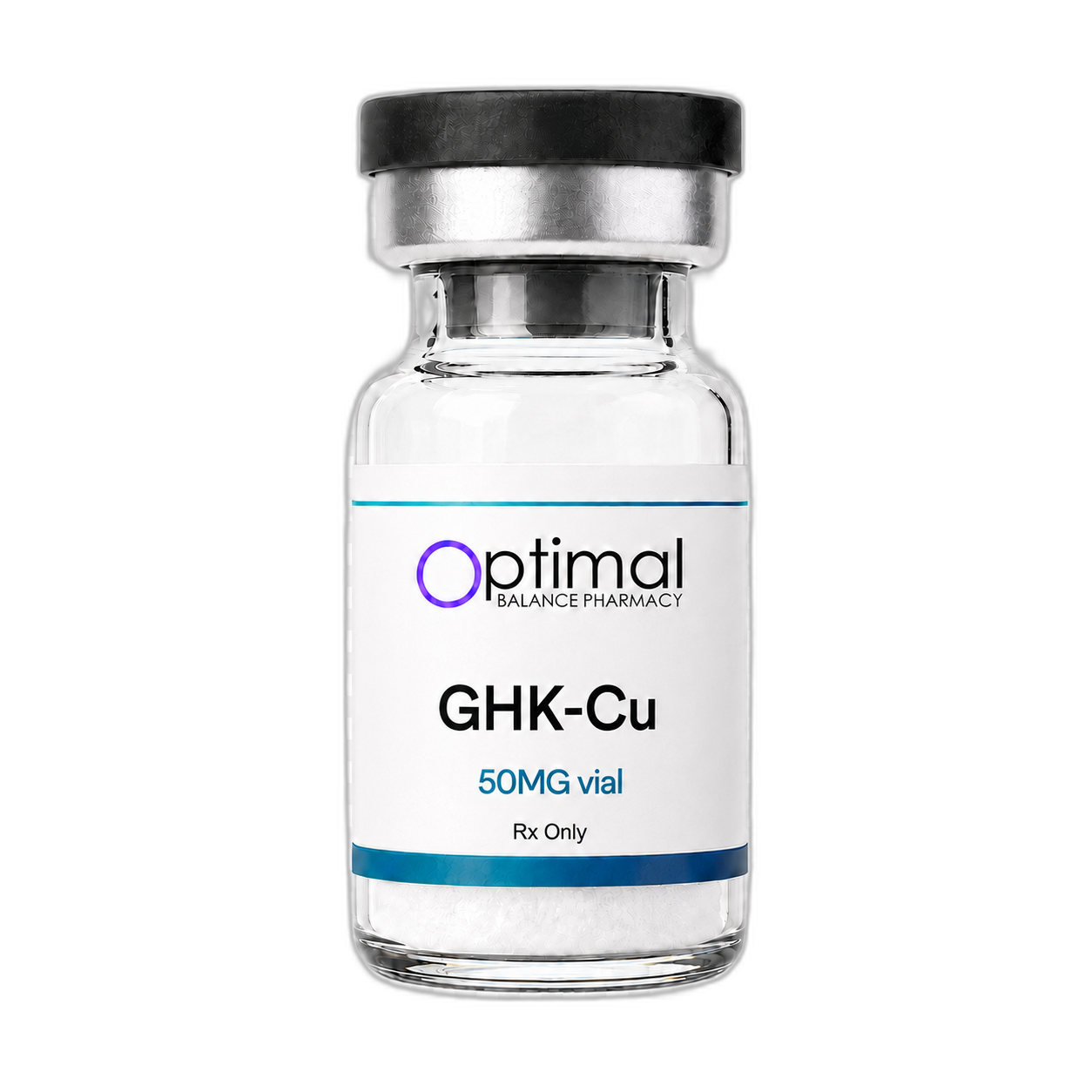
What It Is
GHK-Cu is a copper peptide naturally found in your blood. Levels decline with age. It's one of the most researched peptides for regeneration and anti-aging.
How It Works
It activates thousands of genes involved in healing, promotes collagen and elastin production, attracts immune cells to injury sites, and has potent antioxidant effects.
Who It's For
Those seeking both recovery benefits and anti-aging effects. Excellent for skin health, wound healing, and post-procedural recovery.
Who Should Avoid It
Avoid if allergic to copper. Generally very well-tolerated.
Protocol & Pricing
OBP Pharmacy Price
$80/50mg
You pay pharmacy price. No markup.
Starting Dose
20 units (2mg)
Form
Injectable vial (5mL, 10mg/mL, 50mg total)
Dosing Protocol
20 units subcutaneous injection once daily. Maintenance: 2 to 3 times per week per provider. 20 units = 0.2mL × 10mg/mL = 2mg per injection. Can also be used topically.
Beyond Use Date
90 Days from compounding (USP <797>)
Optimal Balance Pharmacy assigns this date and prints it on your vial label. Always follow the label. Once a multi-dose vial is punctured, the in-use date on the label is shorter than the compounding date shown here.
Stacking Guide
Stacks Well With
Copper tripeptide (skin & tissue)
Read the GHK-Cu protocol guide
Topical has human RCT support. Injectable for cosmetic claims is anecdotal. The copper uglies are real and manageable. Hair-loss support, yes; DHT blocker, no.
Related Peptides
BPC-157
A body protection compound that accelerates tissue repair in tendons, ligaments, muscle, and the GI tract.
$80/15mgEpithalon
A telomerase-activating peptide that may help maintain telomere length. A key marker of cellular aging.
$80/10mgWolverine Stack
The Wolverine Stack: BPC-157 and TB-500 in one vial. Local tissue repair plus systemic recovery in a single foundation healing peptide.
$100/15mg+15mgIndependently tested
GHK-Cu lab test reports
Every GHK-Cu batch dispensed by Optimal Balance Pharmacy is independently tested by Eagle Analytical Services (FDA-registered, A2LA ISO 17025 accredited) for sterility (ScanRDI or Celsis) and bacterial endotoxin (USP <85>). The most recent report:
| Submission | Lot | Sample | Sterility | Endotoxin | |
|---|---|---|---|---|---|
| ETX-260514-0115 | 051126-05 | GHK-CU 10MG/ML 5ML | Pass | Pass <2 EU/mL / 400 EU/mL | Download |
Eagle Analytical Services is an independent FDA-registered laboratory, A2LA accredited to ISO 17025, based in Houston, Texas. They have no commercial relationship with Rx Peps Direct. Rx Peps Direct prescribes; Optimal Balance Pharmacy compounds and dispenses; Eagle tests every batch. Three separate companies. Browse our full quality program on the quality page.
How to get GHK-Cu prescribed online
GHK-Cu is available by prescription through a licensed telehealth visit and dispensed for human use by a named 503A pharmacy. That is what separates it from research-use-only vials sold without a prescription. There is no subscription and no membership, just a one-time visit fee.
- 1
Complete a $39 medical visit. Answer a short intake about your health history and your goals for GHK-Cu. The $39 fee is the only charge Rx Peps Direct collects, paid once, not a recurring subscription.
- 2
A licensed provider reviews it. A US-licensed nurse practitioner or physician reviews your intake and, if GHK-Cu is appropriate for you, writes a patient-specific prescription. The starting dose is typically 20 units (2mg).
- 3
The pharmacy compounds and ships it. Optimal Balance Pharmacy, a 503A pharmacy in Texas, compounds GHK-Cu and ships it pre-reconstituted by FedEx overnight in a reusable cooled case. Your fill is Injectable vial (5mL, 10mg/mL, 50mg total), and you pay the pharmacy $80/50mg at wholesale, with no clinic markup, plus a $15 flat FedEx overnight shipping fee charged by the pharmacy.
Rx Peps Direct prescribes GHK-Cu in the 29 jurisdictions its medical team is licensed in. Start a $39 visit or browse the full Recovery & Repair range. Comparing services first? See how Rx Peps Direct stacks up against seven other providers in our best telehealth for compounded peptides comparison.
Common questions about GHK-Cu
- What is GHK-Cu and what does it do?
- GHK-Cu is a copper-binding tripeptide (glycyl-L-histidyl-L-lysine bound to copper) that occurs naturally in human plasma. Plasma levels decline with age (approximately 60 percent reduction between ages 20 and 60). The peptide signals tissue remodeling, collagen and elastin synthesis, and gene expression linked to wound repair. Published microarray studies document GHK-Cu effects across thousands of human genes related to repair pathways. The GHK-Cu vial Optimal Balance Pharmacy compounds for Rx Peps Direct prescriptions is 50 mg at $80 with a $39 medical visit fee.
- How much GHK-Cu should I inject daily?
- The Rx Peps Direct starting dose is 20 units (2 mg) on a U-100 insulin syringe drawn from the 50 mg vial (which ships pre-reconstituted at 10 mg/mL). Most protocols deliver 1 to 3 mg per day subcutaneously, either daily or 5 days on with 2 days off. Higher doses are not associated with better outcomes in available studies and may increase the chance of injection-site reactions. Your provider sets the protocol based on the intended outcome (skin, wound healing, recovery support).
- Where to inject GHK-Cu?
- GHK-Cu is injected subcutaneously into the abdomen, upper outer thigh, or back of the upper arm. For a localized cosmetic or wound goal, inject as close to the target tissue as safely possible because the peptide acts strongly at the local level. Use a 31-gauge, 5/16-inch (8 mm) needle on a U-100 insulin syringe. Rotate sites between injections.
- How long does GHK-Cu take to work?
- Skin and connective-tissue effects build over 4 to 12 weeks of consistent use. Wound and post-procedural recovery patients often see accelerated healing within the first 7 to 14 days. Hair-related applications (some studies suggest follicle stimulation) typically need 12 to 16 weeks before measurable change. Onset varies with age, baseline tissue health, and protocol consistency.
- Do I have to reconstitute GHK-Cu myself?
- No. The 50 mg GHK-Cu vial Optimal Balance Pharmacy ships for Rx Peps Direct prescriptions is already reconstituted at 10 mg/mL and ready to inject. At that concentration, 20 units (0.2 mL) on a U-100 insulin syringe equals 2 mg per dose. You do not need to mix anything, supply bacteriostatic water, or wait for the powder to dissolve. This is a structural difference from research-grade GHK-Cu sold as a lyophilized powder, where the user has to source bac water separately (currently on national shortage) and reconstitute by hand.
- Can I use GHK-Cu topically for skin?
- Topical GHK-Cu serums are widely available but they deliver a much lower concentration to the dermis than subcutaneous injection because the peptide does not readily cross intact skin. The GHK-Cu Optimal Balance Pharmacy compounds is a sterile injectable intended for subcutaneous administration; do not pour the injectable solution onto skin or use it cosmetically. If your goal is purely cosmetic skin support, a separate topical GHK-Cu product is more appropriate; ask your provider for guidance.
- Is GHK-Cu safe long-term?
- GHK-Cu is endogenous to human plasma and has no documented long-term toxicity at therapeutic doses. The most common adverse effects are mild injection-site reactions and rare transient flushing. Patients with copper allergy should avoid GHK-Cu. Patients with Wilson's disease or other copper-metabolism disorders should not use it. Your Rx Peps Direct provider screens for these conditions during intake.