Ondansetron 4mg ODT
A 5-HT3 receptor antagonist that blocks the serotonin signaling pathway responsible for nausea and vomiting.
 Medically reviewed by Dr. Jonathan Snipes, MD. Last reviewed May 6, 2026.
Select quantity (tablets per fill)
Pick a count before adding this to your protocol.
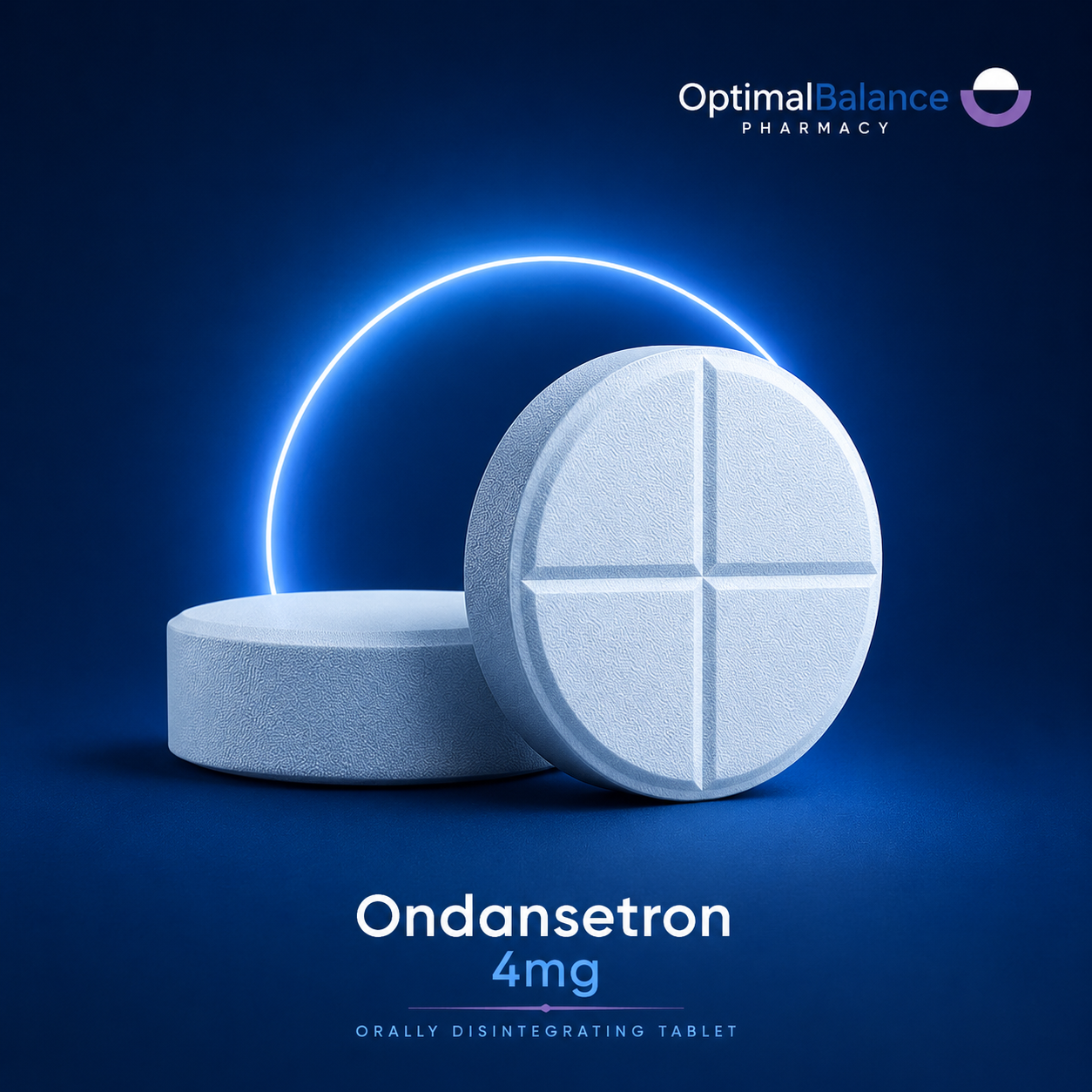
What It Is
Ondansetron is the generic name for Zofran®. The orally disintegrating tablet (ODT) form melts on the tongue, no water needed. Useful when nausea is acute. Prescribed as an adjunct to GLP-1 therapy for patients who experience breakthrough nausea during dose titration.
How It Works
Ondansetron blocks serotonin (5-HT3) receptors in the gut and brain that trigger the nausea reflex. It does not treat nausea by sedating you. It interrupts the chemical signal directly.
Who It's For
Patients on semaglutide or tirzepatide who experience nausea during the first 4 to 8 weeks of titration, or whenever a dose increase brings it back. Use as needed, not on a schedule.
Who Should Avoid It
Avoid in patients with congenital long QT syndrome. Use caution with other QT-prolonging medications. Not for chronic daily use.
Protocol & Pricing
OBP Pharmacy Price
$1.25/tablet
You pay pharmacy price. No markup.
Starting Dose
1 tablet (4mg) every 8 hours as needed for nausea
Form
Orally disintegrating tablet (4mg × 30 tablets per pack)
Dosing Protocol
1 tablet (4mg) dissolved on the tongue every 8 hours as needed for nausea. Maximum 3 tablets per 24 hours. Take 30 to 60 minutes before a GLP-1 dose if nausea is anticipated.
Beyond Use Date
N/A (manufactured drug, follow expiration on package)
Optimal Balance Pharmacy assigns this date and prints it on your vial label. Always follow the label. Once a multi-dose vial is punctured, the in-use date on the label is shorter than the compounding date shown here.
Stacking Guide
Stacks Well With
Related Peptides
Semaglutide/B12
The gold standard GLP-1 for weight management, paired with B12 for energy support.
From $25/1.2mgSemaglutide/B6 + Glycine
Glycine-buffered semaglutide for patients who don't tolerate the B12 cofactor.
From $175/10mgTirzepatide/B12
Dual GIP/GLP-1 receptor agonist for enhanced metabolic support with B12.
From $45/12mgHow to get Ondansetron 4mg ODT prescribed online
Ondansetron 4mg ODT is a manufactured generic medication available by prescription through a licensed telehealth visit, dispensed by the same 503A pharmacy that fills RxPepsDirect peptide prescriptions. There is no subscription and no membership, just a one-time visit fee.
- 1
Complete a $39 medical visit. Answer a short intake about your health history and your goals for Ondansetron 4mg ODT. The $39 fee is the only charge RxPepsDirect collects, paid once, not a recurring subscription.
- 2
A licensed provider reviews it. A US-licensed nurse practitioner or physician reviews your intake and, if Ondansetron 4mg ODT is appropriate for you, writes a patient-specific prescription. The starting dose is typically 1 tablet (4mg) every 8 hours as needed for nausea.
- 3
The pharmacy fills and ships it. Optimal Balance Pharmacy, a 503A pharmacy in Texas, fills Ondansetron 4mg ODT as packaged manufactured product and ships it by FedEx overnight. Your fill is Orally disintegrating tablet (4mg × 30 tablets per pack), and you pay the pharmacy $1.25/tablet at wholesale, with no clinic markup, plus a $15 flat FedEx overnight shipping fee charged by the pharmacy.
RxPepsDirect prescribes Ondansetron 4mg ODT in the 29 jurisdictions its medical team is licensed in. Start a $39 visit or browse the full Weight Loss & Metabolic range. Comparing services first? See how RxPepsDirect stacks up against seven other providers in our best telehealth for compounded peptides comparison.
Common questions about Ondansetron 4mg ODT
- What is ondansetron and why is it prescribed alongside peptide protocols?
- Ondansetron is a 5-HT3 serotonin receptor antagonist FDA-approved as Zofran for chemotherapy-induced and post-operative nausea. RxPepsDirect providers prescribe it as a PRN anti-nausea adjunct for patients on GLP-1 protocols (compounded tirzepatide and semaglutide), where titration nausea is the most common reason patients struggle to maintain the protocol. The 4 mg orally disintegrating tablet (ODT) provides relief within 30 minutes without requiring a glass of water.
- Is ondansetron safe to take with GLP-1s like tirzepatide and semaglutide?
- Yes. Ondansetron has no clinically meaningful drug-drug interaction with tirzepatide or semaglutide. It is one of the most-studied anti-nausea drugs in modern medicine and has been used safely alongside GLP-1s in millions of patient-courses. The most common side effects are mild headache and constipation. Ondansetron can prolong the QT interval at high doses, so patients with known long-QT syndrome or on QT-prolonging medications should ask their provider.
- How do I take the 4 mg ODT for nausea?
- Place one 4 mg orally disintegrating tablet on the tongue and let it dissolve (no water needed). Take at the first sign of nausea, ideally before nausea becomes severe. Most patients feel relief within 30 minutes. Do not exceed 8 mg in any 8-hour window without provider review.
- How often can I take ondansetron during GLP-1 titration?
- Ondansetron is dosed PRN (as needed) during the first 4 to 8 weeks of GLP-1 titration. A common pattern is one 4 mg ODT in the morning of the GLP-1 dose day if nausea typically peaks then. Do not exceed 8 mg in 8 hours without provider review. If you need to dose ondansetron more than 3 days per week to function, message your provider; the GLP-1 dose may need to step back instead.
- Are there contraindications for ondansetron?
- Avoid ondansetron with apomorphine (severe hypotension risk). Patients with congenital long-QT syndrome should not use ondansetron. Patients on QT-prolonging medications (some antidepressants, antipsychotics, antimicrobials) should ask their provider before starting. Use during pregnancy is generally considered acceptable for severe nausea but warrants provider review.
- What is the difference between ondansetron ODT and regular ondansetron tablets?
- Both contain the same 4 mg of ondansetron and work identically once absorbed. The ODT (orally disintegrating tablet) dissolves on the tongue in seconds with no water, which matters when you are actively nauseous and keeping water down is part of the problem. Regular film-coated ondansetron tablets have to be swallowed whole. RxPepsDirect providers prescribe the ODT form for GLP-1 titration nausea for exactly that reason.
- Do I need a prescription for ondansetron 4 mg tablets?
- Yes. Ondansetron is prescription-only in the United States in every form, including the 4 mg ODT. An RxPepsDirect provider can prescribe it after a $39 online visit at rxpepsdirect.com/get-script, and most patients add it to the same order as their GLP-1, so one visit fee covers both. Optimal Balance Pharmacy fills the prescription and ships it with the rest of the order.
- How much does ondansetron cost through RxPepsDirect?
- The pharmacy bills $37.50 for 30 orally disintegrating 4 mg tablets at its wholesale rate with no clinic markup, and you can select 30 to 120 tablets per fill. The only RxPepsDirect charge is the flat $39 visit fee, and adding ondansetron to a GLP-1 order does not add a second fee: one $39 order covers up to 3 different medications. A local pharmacy with insurance or a discount card may price generic ondansetron lower; the value here is having it prescribed in the same visit and shipped in the same package as your GLP-1.