Tirzepatide/B12
A dual incretin that activates both GIP and GLP-1 receptors for powerful metabolic regulation.
 Medically reviewed by Dr. Jonathan Snipes, MD. Last reviewed May 6, 2026.
Select vial size
Checking your status…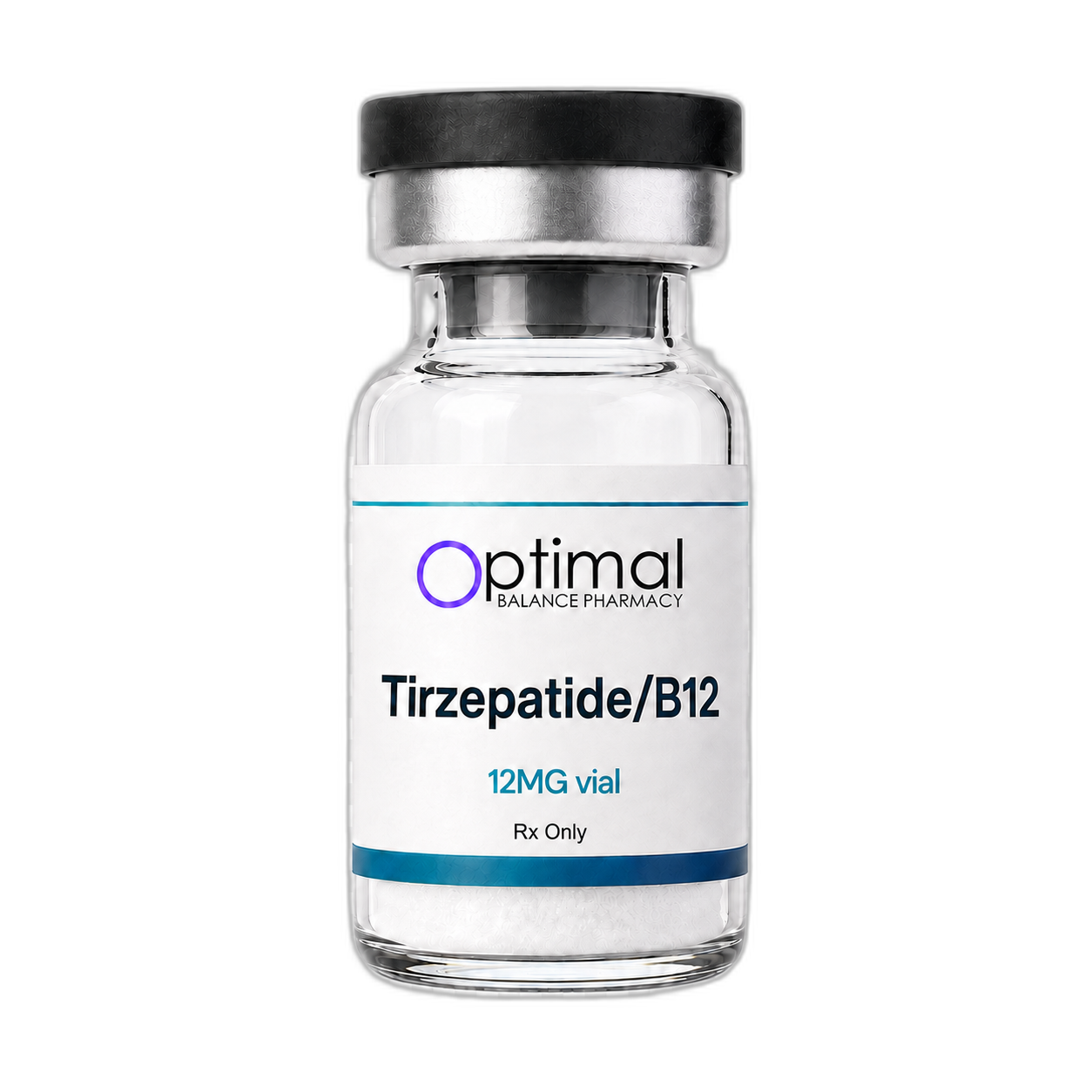
What It Is
Tirzepatide is a dual GIP/GLP-1 receptor agonist. The same class as Mounjaro® and Zepbound®. It targets two hormonal pathways instead of one, often producing stronger results.
How It Works
By activating both GIP and GLP-1 receptors, tirzepatide provides a dual-action approach to appetite control, blood sugar regulation, and metabolic enhancement.
Who It's For
Adults seeking maximum pharmaceutical weight management support, especially those who may have plateaued on single-pathway GLP-1 medications.
Who Should Avoid It
Same as semaglutide: avoid with thyroid cancer history, MEN2, pancreatitis, gastroparesis, or pregnancy.
Protocol & Pricing
OBP Pharmacy Price
From $45/12mg
You pay pharmacy price. No markup.
Starting Dose
25 units (1.5mg) twice weekly
Form
Injectable vial (2mL, 6mg/mL, 12mg total. Starter concentration; titration vials up to 180mg available)
Dosing Protocol
25 units subcutaneous injection twice weekly. Titrate up concentration as tolerated. 25 units = 0.25mL × 6mg/mL = 1.5mg per injection (starter vial). Hold or step back dose if nausea. Hydration & protein mitigate side effects. Full dose ladder (pharmacy passthrough at OBP wholesale, no markup): 12mg vial $45 · 24mg $90 · 34mg $127.50 · 44mg $165 · 56mg $210 · 66mg $247.50 · 30mg/3mL $112.50 · 52.5mg $196.88 · 60mg $225 · 180mg $675.
Beyond Use Date
Up to 120 Days from compounding (USP <797>)
Optimal Balance Pharmacy assigns this date and prints it on your vial label. Always follow the label. Once a multi-dose vial is punctured, the in-use date on the label is shorter than the compounding date shown here.
Compounded Tirzepatide Dosage Chart: Titration Schedule & Pricing
25 units subcutaneous twice weekly. Concentration steps up monthly; each vial is a 30-day supply at the indicated dose.
| Month | Vial | Price | Access |
|---|---|---|---|
| 1 | 12mg | $45 | Starter |
| 2 | 24mg | $90 | Active Rx Required |
| 3 | 34mg | $127.50 | Active Rx Required |
| 4 | 44mg | $165 | Active Rx Required |
| 5 | 56mg | $210 | Active Rx Required |
| 6+ | 66mg | $247.50 | Active Rx Required |
Bulk Refills for Established Patients
Once you're on maintenance dose, refill at higher vial sizes for fewer reorders. All bulk refills require an active prescription.
| Type | Vial | Price | Access |
|---|---|---|---|
| Refill | 30mg | $112.50 | Active Rx Required |
| Refill | 52.5mg | $196.88 | Active Rx Required |
| Refill | 60mg | $225 | Active Rx Required |
| Refill | 180mg | $675 | Active Rx Required |
Month 1: Starter, no prior Rx needed
Month 6+: Maintenance concentration
All prices are pharmacy passthrough at Optimal Balance Pharmacy wholesale, no markup. Add the flat $39 medical visit fee on your first order. Titration schedule above reflects the standard Rx Peps Direct protocol; your provider may adjust based on tolerance and clinical response.
Medical Records & Prescription Verification
Required for any Tirzepatide/B12 order after the starter vial.
Why this is required
Unlike other peptides we prescribe, GLP-1 medications (semaglutide and tirzepatide) carry real medical risk when titration is not supervised by a physician. Over-dosing or skipping titration steps can cause severe nausea, dehydration, gastroparesis (delayed stomach emptying), and in rare cases pancreatitis or hypoglycemic events.
People with a personal or family history of medullary thyroid carcinoma, MEN2 syndrome, active pancreatitis, or severe gastroparesis should not take GLP-1 agonists at all. These are decisions that have to be made between a patient and their provider, not by a website.
For these reasons, the FDA-approved versions (Ozempic®, Wegovy®, Mounjaro®, Zepbound®) require a prescription. Our compounded versions follow the same standard. The starter vial needs no prior prescription: your provider can prescribe it after your initial Rx Peps Direct medical visit. Every later vial (whether you titrate up with us or refill at a maintenance dose) requires us to verify that you are under active medical care for this medication.
What you can upload
- A copy of your current prescription (PDF or photo)
- A medical record or chart note from your prescribing provider showing the active medication and dose
- A pharmacy printout or label from your most recent fill
- A recent lab result with your provider's name and the medication noted
Existing Rx Peps Direct patients on Sema or Tirz: we'll auto-match your email to your prior approved visit. No additional upload required for routine ladder step-ups.
When you'll upload
You'll upload your documentation during onboarding, after you complete the intake form and the contraindication review, just before consent. Existing Rx Peps Direct patients are auto-verified by email match and skip this step.
Begin onboarding →Stacking Guide
Stacks Well With
Do Not Combine With
GLP-1 protocol guide
Read the Tirzepatide/B12 protocol guide
Microdosing semaglutide or tirzepatide means running them below the FDA-approved starter dose. The vial-duration math, the published evidence, and how to start with a provider.
Related Peptides
Lipo-B (Cyanocobalamin/MIC)
A lipotropic injection combining cyanocobalamin (B12) with methionine, inositol, and choline for fat metabolism.
From $30/10mlLipo-C (Cyanocobalamin/MIC/L-Carnitine)
Enhanced lipotropic injection adding L-carnitine to cyanocobalamin and MIC for improved energy and fat transport.
From $35/10mlOndansetron 4mg ODT
Anti-nausea adjunct for GLP-1 patients. Generic Zofran orally disintegrating tablets.
$1.25/tabletIndependently tested
Tirzepatide/B12 lab test reports
Every Tirzepatide/B12 batch dispensed by Optimal Balance Pharmacy is independently tested by Eagle Analytical Services (FDA-registered, A2LA ISO 17025 accredited) for sterility (ScanRDI or Celsis) and bacterial endotoxin (USP <85>). The 5 most recent reports of 33 on file:
| Submission | Lot | Sample | Sterility | Endotoxin | |
|---|---|---|---|---|---|
| ETX-260921-0788 | LG342010800 | TIRZEPATIDE/ B12 12 MG/ 500 MCG/ML (2 ML) Injection | Pass | Pass <2 EU/mL / 1400 EU/mL | Download |
| ETX-260918-0137 | LG342010703 | TIRZEPATIDE/ B12 6 MG/ 500 MCG/ML (2 ML) Injection | Pass | Pass <2 EU/mL / 1400 EU/mL | Download |
| ETX-260918-0465 | LG342010723 | TIRZEPATIDE/ B12 17 MG/ 500 MCG/ML (2 ML) Injection | Pass | Pass <2 EU/mL / 1400 EU/mL | Download |
| ETX-260918-0473 | LG342010726 | TIRZEPATIDE/ B12 30 MG/ 500 MCG/ML (6ML) Injection | Pass | Pass <2 EU/mL / 1400 EU/mL | Download |
| ETX-260917-0316 | LG342010708 | TIRZEPATIDE/ B12 33 MG/ 500 MCG/ML (2 ML) Injection | Pass | Pass <10 EU/mL / 1400 EU/mL | Download |
Eagle Analytical Services is an independent FDA-registered laboratory, A2LA accredited to ISO 17025, based in Houston, Texas. They have no commercial relationship with Rx Peps Direct. Rx Peps Direct prescribes; Optimal Balance Pharmacy compounds and dispenses; Eagle tests every batch. Three separate companies. Browse our full quality program on the quality page.
Why this is legal in 2026
Compounded tirzepatide is dispensed under Section 503A of the Federal Food, Drug, and Cosmetic Act, which authorizes a state-licensed pharmacy to compound a drug for an identified individual patient with documented medical need. Each prescription is patient-specific, written by a licensed nurse practitioner or physician assistant after a documented telehealth visit, and dispensed by Optimal Balance Pharmacy in Texas.
The FDA enforcement-discretion period that allowed mass compounding during the tirzepatide shortage ended on March 19, 2025 for 503B outsourcing facilities and February 18, 2025 for 503A pharmacies. The 503A patient-specific exception is statutory and was not affected by either deadline.
Full breakdown of the pathway, the regulatory citations, and the documented medical-need criteria Rx Peps Direct providers use is on our compounded tirzepatide legality page.
GLP-1 medications are compounded semaglutide or tirzepatide. Compounded versions are not the same as branded Ozempic®, Wegovy®, Mounjaro®, or Zepbound®. Compounded medications are prepared by licensed pharmacies and are not FDA-approved drug products.
How to get Tirzepatide/B12 prescribed online
Compounded Tirzepatide is available by prescription through a licensed telehealth visit, then dispensed by a named 503A pharmacy under the patient-specific pathway. There is no subscription and no membership, just a one-time visit fee.
- 1
Complete a $39 medical visit. Answer a short intake about your health history and your goals for Tirzepatide/B12. The $39 fee is the only charge Rx Peps Direct collects, paid once, not a recurring subscription.
- 2
A licensed provider reviews it. A US-licensed nurse practitioner or physician reviews your intake and, if Tirzepatide/B12 is appropriate for you, writes a patient-specific prescription. The starting dose is typically 25 units (1.5mg) twice weekly.
- 3
The pharmacy compounds and ships it. Optimal Balance Pharmacy, a 503A pharmacy in Texas, compounds Tirzepatide/B12 and ships it pre-reconstituted by FedEx overnight in a reusable cooled case. Your fill is Injectable vial (2mL, 6mg/mL, 12mg total. Starter concentration; titration vials up to 180mg available), and you pay the pharmacy From $45/12mg at wholesale, with no clinic markup, plus a $15 flat FedEx overnight shipping fee charged by the pharmacy.
Rx Peps Direct prescribes Tirzepatide/B12 in the 29 jurisdictions its medical team is licensed in. Start a $39 visit or browse the full Weight Loss & Metabolic range. Comparing services first? See how Rx Peps Direct stacks up against seven other providers in our best telehealth for compounded peptides comparison.
Common questions about Tirzepatide/B12
- What is Tirzepatide/B12 from Rx Peps Direct?
- Tirzepatide/B12 is a compounded injectable that pairs tirzepatide, a dual GIP and GLP-1 receptor agonist, with cyanocobalamin (vitamin B12). Tirzepatide is the same active ingredient as Mounjaro and Zepbound. The compound is dispensed by Optimal Balance Pharmacy under a 503A patient-specific prescription. Every batch is tested by Eagle Analytical Services for sterility and bacterial endotoxin (USP <85>); the Certificate of Analysis is published on this page. Vial sizes range from a 12 mg starter at $45 to a 180 mg vial at $675, with a flat $39 medical visit fee.
- Does compounded tirzepatide work the same as Mounjaro or Zepbound?
- Compounded tirzepatide uses the same active ingredient as Mounjaro and Zepbound: tirzepatide. The dose-response and mechanism are identical because the molecule is the same. The compounded version Optimal Balance Pharmacy dispenses is co-formulated with cyanocobalamin (B12), which is pharmacologically inert with respect to weight loss; the B12 supports energy levels during caloric deficit but does not change tirzepatide's pharmacology. The pivotal SURMOUNT-1 trial showed 15 to 22 percent mean body weight loss over 72 weeks at therapeutic doses; that data applies because the active molecule is identical. The Rx Peps Direct protocol does use a different dosing schedule than branded Mounjaro (1.5 mg twice weekly versus 2.5 mg once weekly); see the next question for why.
- What is the starting dose of compounded tirzepatide at Rx Peps Direct?
- The Rx Peps Direct starting protocol is 25 units (1.5 mg) on a U-100 insulin syringe, taken subcutaneously twice weekly, for a total of 3 mg per week. Branded Mounjaro and Zepbound use 2.5 mg once weekly per Lilly's prescribing information. The split-dose protocol used by many compounding telehealth clinics is intended to smooth the Cmax peak that drives nausea: tirzepatide has a roughly 120-hour half-life (StatPearls pharmacokinetics) and once-weekly dosing produces a peak 8 to 72 hours post-injection where GI side effects cluster. Splitting the dose flattens the AUC curve and lowers that peak. Pharmacokinetic modeling and clinical experience support this approach, though no head-to-head randomized trial has compared 1.5 mg twice weekly versus 2.5 mg once weekly. Your provider may adjust based on your medical history, GLP-1 treatment history, and side-effect tolerance.
- How does Rx Peps Direct's twice-weekly protocol compare to Mounjaro's once-weekly schedule, and how do the units work?
- On the Rx Peps Direct protocol, the starting dose is 25 units (1.5 mg) twice weekly drawn from a 6 mg/mL starter vial; 25 units equals 0.25 mL on a U-100 insulin syringe. For reference, the branded Mounjaro 2.5 mg once-weekly equivalent on a 6 mg/mL vial would be approximately 42 units (0.42 mL), but that schedule is not the Rx Peps Direct protocol. Always verify the concentration printed on your specific vial before drawing, because Optimal Balance Pharmacy ships multiple concentrations across the titration ladder and the unit-to-mg ratio changes with each strength. Your shipment includes a per-vial unit conversion table for safety.
- What is the compounded tirzepatide dosage chart?
- The compounded tirzepatide chart starts at 1.5 mg twice weekly (3 mg per week) from the 12 mg starter vial and steps up monthly only if tolerated: 6 mg, 8.5 mg, 11 mg, 14 mg, then a 16.5 mg-per-week maintenance strength at month 6. Each vial is a 30-day supply at its indicated dose, billed at Optimal Balance Pharmacy wholesale. The full chart with concentrations and per-injection doses is published on this page, and your prescription label always takes precedence over it.
- Why is the compounded tirzepatide co-formulated with cyanocobalamin (B12)?
- Cyanocobalamin is a soluble carrier that doubles as an energy-supporting cofactor for patients in caloric deficit. B12 supports red blood cell production and methylation pathways that come under load during rapid fat loss. The 0.5 mg/mL inclusion is well below any clinical toxicity threshold and has no effect on tirzepatide's GIP or GLP-1 receptor binding. The B12 carrier is a formulation choice by Optimal Balance Pharmacy, not by Rx Peps Direct; Rx Peps Direct is the prescribing source. Patients with documented B12 sensitivity or MTHFR methylation variants should ask their provider about the Tirzepatide/Glycine variant instead.
- Where do I inject tirzepatide?
- Tirzepatide is injected subcutaneously into the abdomen, the upper outer thigh, or the back of the upper arm. Rotate sites with each injection. Avoid the same location within a 1-inch radius of any prior injection in the past 7 days. The needle should be 31-gauge and 5/16-inch (8 mm) on a U-100 insulin syringe (included with every Rx Peps Direct order). Pinch the skin and inject at a 90-degree angle. For step-by-step technique, see the Rx Peps Direct injection guide.
- Does tirzepatide cause hair loss?
- Hair loss is reported in approximately 5 percent of tirzepatide users in clinical trial data. The mechanism is generally telogen effluvium driven by rapid weight loss rather than a direct effect of tirzepatide, similar to what is seen after bariatric surgery or any aggressive caloric deficit. Most cases are temporary and resolve within 3 to 6 months once weight stabilizes. Adequate protein intake (at least 1 gram per kilogram of body weight per day) and complete-vitamin coverage reduce risk.
- Does tirzepatide make you tired?
- Fatigue is a documented side effect of tirzepatide, particularly during the first 4 to 6 weeks of titration. The cause is multifactorial: reduced caloric intake, slower gastric emptying, mild dehydration if water intake drops with appetite, and elevated B12 demand during a rapid metabolic shift. The B12 in the Optimal Balance Pharmacy formulation directly addresses the last factor. If fatigue persists beyond 6 weeks, message your provider through the dashboard for a protocol review.
- How long does tirzepatide last in the fridge once opened?
- Compounded tirzepatide vials carry a Beyond Use Date (BUD) of 90 days from compounding, a date Optimal Balance Pharmacy assigns from the preparation, container and storage rather than one USP <797> prescribes. The BUD is printed on every vial label by Optimal Balance Pharmacy. Refrigerate unopened vials at 36 to 46 degrees Fahrenheit. Once a vial is punctured for first use, follow the in-use BUD printed on your specific label (typically 28 days at refrigerator temperature), which is separate from and shorter than the 90-day compounding date. Do not freeze.
- Is tirzepatide better than semaglutide for weight loss?
- Tirzepatide and semaglutide have both been studied in pivotal trials for weight loss. The SURMOUNT-1 trial reported 15 to 22 percent mean body weight loss on tirzepatide over 72 weeks; the STEP-1 trial reported approximately 14.9 percent on semaglutide over 68 weeks. Tirzepatide's dual GIP and GLP-1 receptor activation typically produces stronger appetite suppression than semaglutide's GLP-1-only mechanism. Semaglutide is often preferred for patients with milder weight-loss goals or histories of severe GI side effects, because tirzepatide tends to produce stronger nausea during titration. Your Rx Peps Direct provider will recommend based on your medical history.