- What is Tirzepatide/Glycine from Rx Peps Direct?
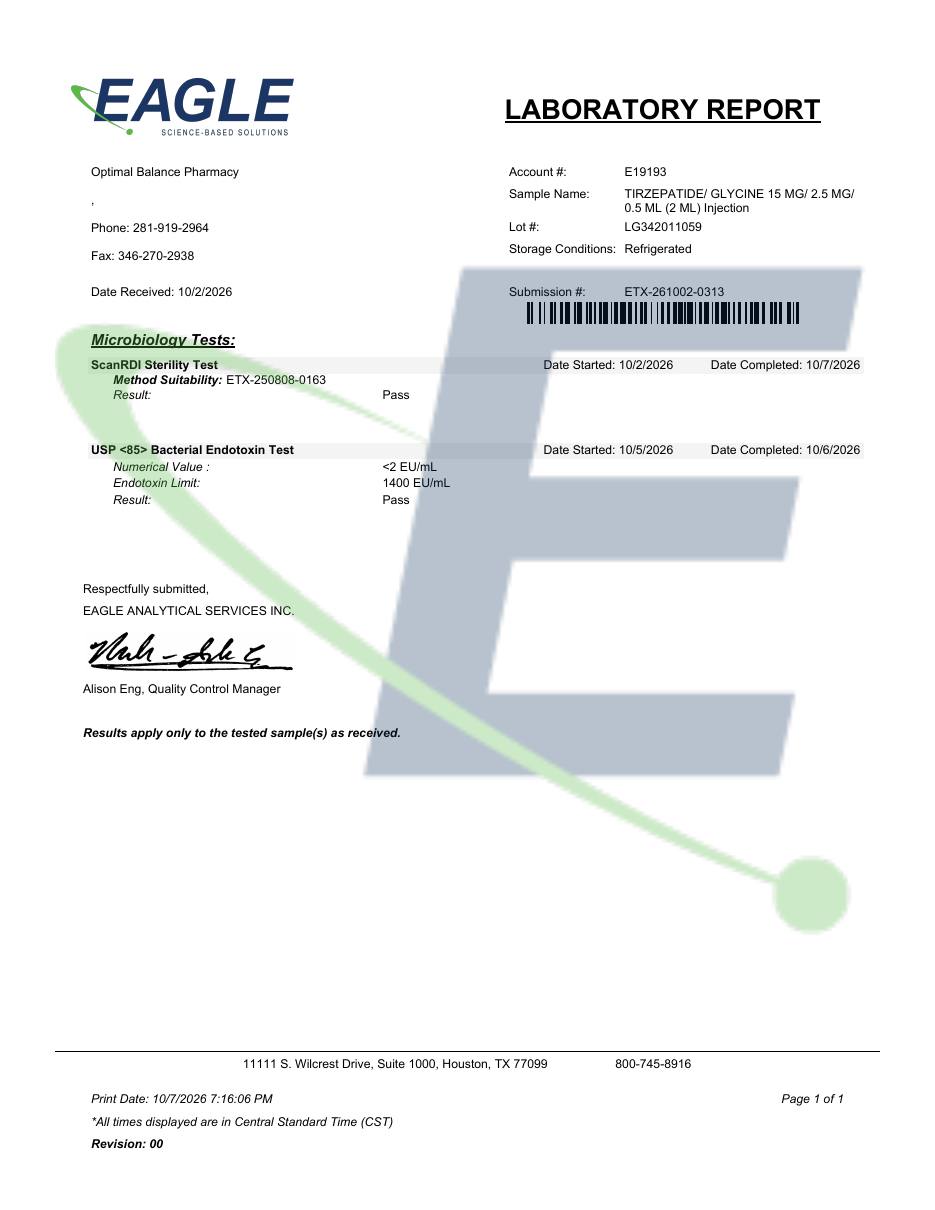
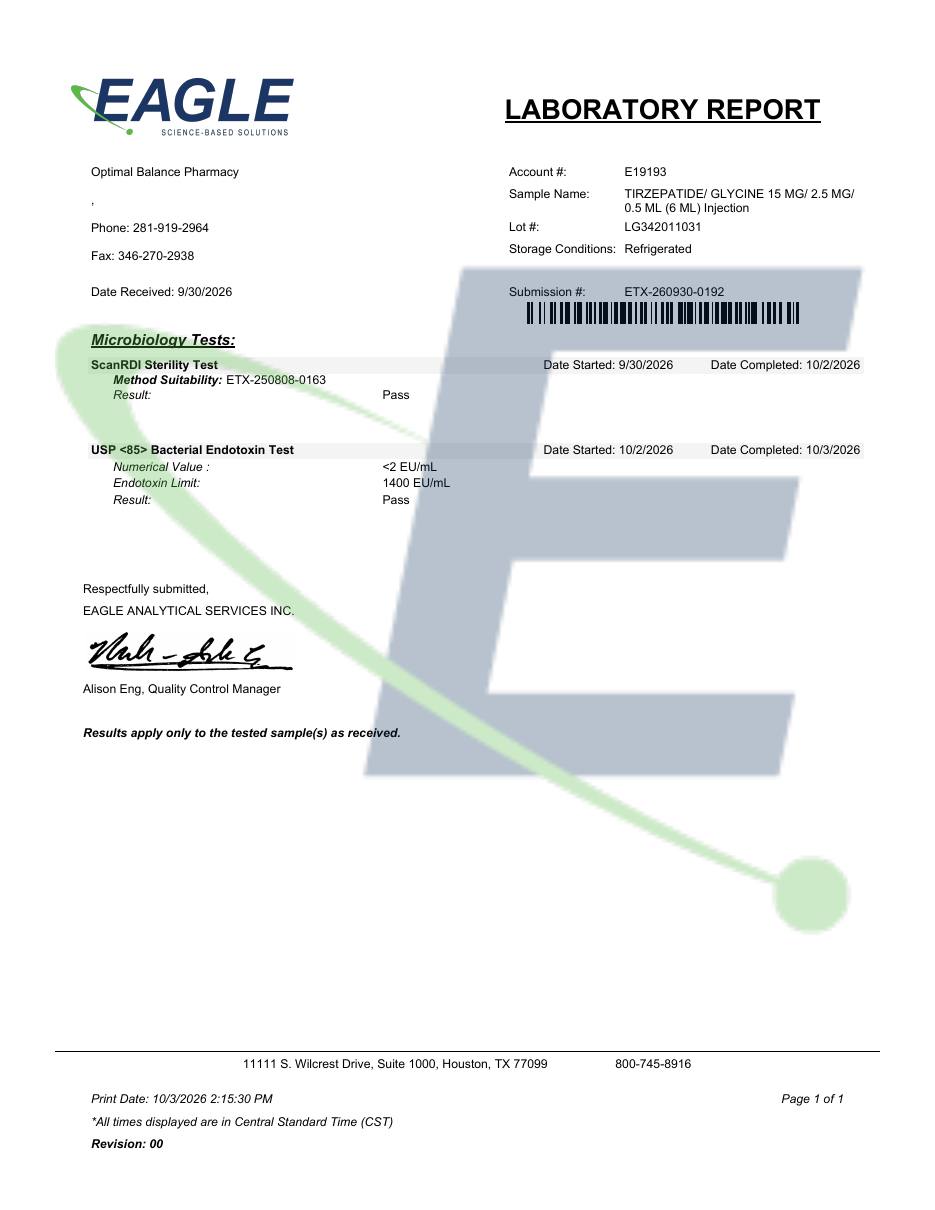
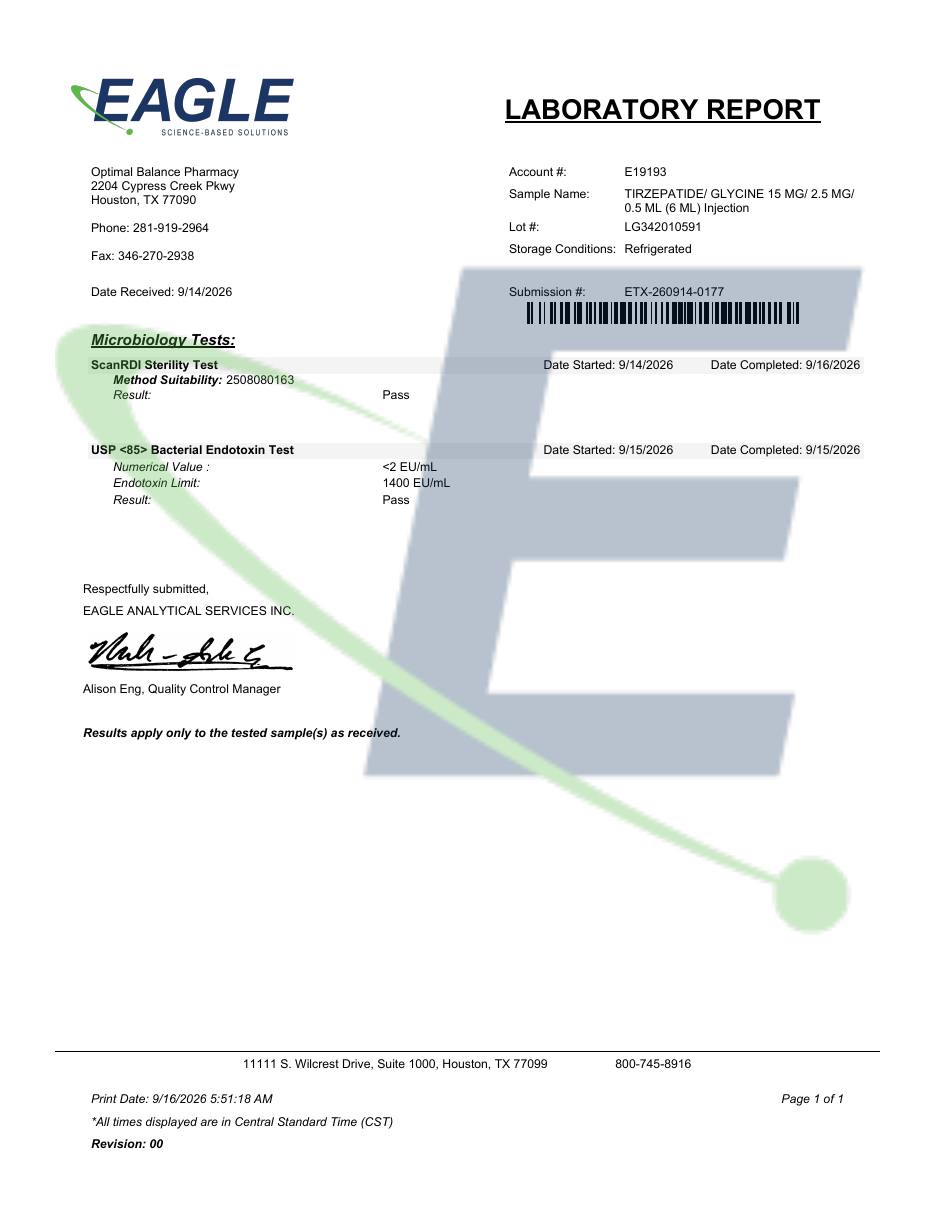
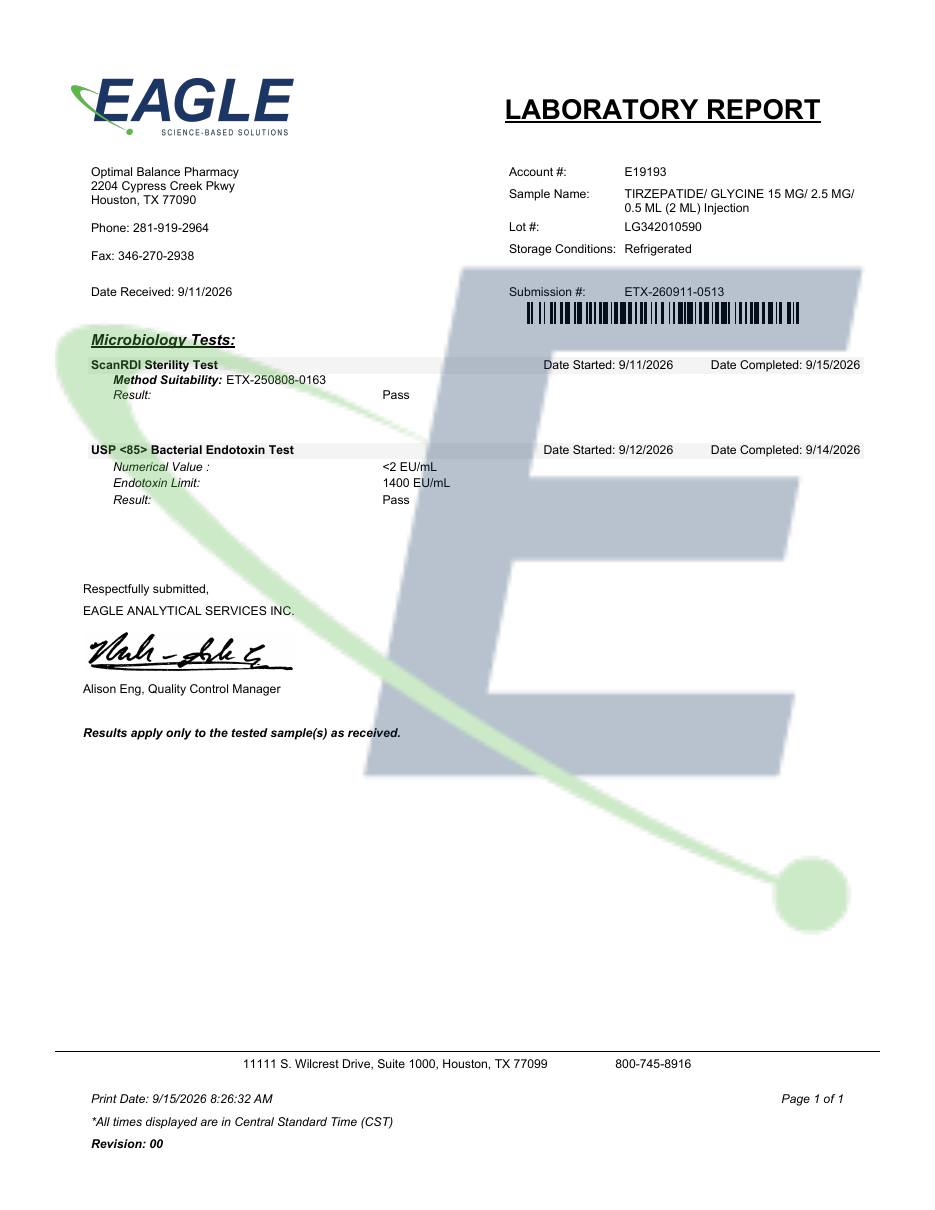
- Tirzepatide/Glycine is the same dual GIP and GLP-1 receptor agonist as Tirzepatide/B12, formulated with glycine and vitamin B6 instead of cyanocobalamin (B12) as the buffer carrier. Two vial sizes are available: 60 mg total at $180 and 180 mg total at $540, with a flat $39 medical review. The pharmacy compounds the formulation under a 503A patient-specific prescription. Eagle Analytical Services tests every batch for sterility (ScanRDI or Celsis) and bacterial endotoxin (USP <85>); the Certificate of Analysis is published on this page.
- What's the difference between the Glycine and B12 variants of compounded tirzepatide?
- The active ingredient (tirzepatide) is identical in both formulations, so the weight-loss mechanism, dose response, and clinical effect are the same. The only difference is the carrier: cyanocobalamin (B12) in the standard formulation versus glycine with vitamin B6 in the Glycine variant. Glycine is a simple amino acid that buffers the solution and supports liver phase-II detoxification pathways. The Glycine variant is typically prescribed when a patient has documented B12 sensitivity, an MTHFR methylation gene variant, or when their provider wants a cleaner cofactor profile. Both formulations are compounded by a licensed U.S. 503A compounding pharmacy.
- Why is glycine in the formulation?
- Glycine is included as a stabilizing buffer and as a small functional support for hepatic glutathione synthesis. It is pharmacologically inert with respect to GIP and GLP-1 receptor activation. The amount per vial is well within physiologic range and does not exceed typical dietary glycine intake from a day of protein-containing meals. The B6 (pyridoxine) supports homocysteine metabolism and is included at a microdose.
- Is the dose ladder the same as Tirzepatide/B12?
- Dosing matches standard tirzepatide because the molecule is the same. Your provider titrates per your response and tolerance, typically starting at 1.5 mg twice weekly and stepping up every 4 weeks if tolerated. The two Glycine vial sizes (60 mg and 180 mg at 15 mg-2.5 mg per 0.5 mL) accommodate both starter and maintenance dosing without frequent vial changes during titration.
- What is the compounded tirzepatide glycine dosage chart?
- Compounded tirzepatide with glycine follows the standard compounded tirzepatide schedule: 1.5 mg twice weekly (3 mg per week) to start, stepped up monthly only if tolerated, reaching a 16.5 mg-per-week maintenance strength by month 6. The full chart with per-injection doses is published on this page. Your provider draws that same schedule from the glycine vials, and your prescription label always takes precedence over the chart.
- How long is Tirzepatide/Glycine stable after compounding?
- Tirzepatide/Glycine carries a Beyond Use Date (BUD) of 90 days from compounding, a date a licensed U.S. 503A compounding pharmacy assigns from the preparation, container and storage rather than one USP <797> prescribes, the same as the B12 variant. The BUD is printed on every vial label by the pharmacy. Refrigerate unopened vials at 36 to 46 degrees Fahrenheit. Once opened, keep the vial in the fridge and use it until it is empty or it reaches the date printed on its label, whichever comes first.
- Where does Rx Peps Direct test Tirzepatide/Glycine for sterility?
- Every batch of Tirzepatide/Glycine is tested by Eagle Analytical Services, an FDA-registered, A2LA ISO 17025-accredited independent laboratory in Houston, Texas. Sterility is tested using the ScanRDI or Celsis platform. Bacterial endotoxin is tested under USP <85>. The Certificate of Analysis for the specific lot you receive is linked from this product page and from the central /quality page; you can verify the lot number on your shipping label against the published report.
- Can I switch from Tirzepatide/B12 to Tirzepatide/Glycine?
- Switching between the B12 and Glycine variants is a clinical decision your Rx Peps Direct provider makes. Common reasons to switch include documented B12 sensitivity, MTHFR methylation variants, copper-zinc imbalance, or patient preference for a simpler cofactor profile. The active dose remains the same; only the carrier changes. Message your provider through your dashboard to request the switch and include the reason so they can document the rationale in your chart.
- Does Tirzepatide/Glycine work for weight loss the same as Mounjaro?
- Yes. Tirzepatide/Glycine uses the same active ingredient (tirzepatide) at the same dose as Mounjaro, so the weight-loss mechanism is identical. The carrier (glycine + B6) is pharmacologically inert with respect to GIP and GLP-1 receptor activation. Clinical trial data on tirzepatide showed 15 to 22 percent mean body weight loss over 72 weeks at therapeutic doses; that data applies to the Glycine variant because the molecule is the same.
- What side effects should I expect on Tirzepatide/Glycine?
- The side-effect profile mirrors standard tirzepatide: nausea (most common during dose escalation), reduced appetite, constipation, occasional diarrhea, fatigue in the first 4 to 6 weeks, and rare hair shedding tied to rapid weight loss. Some patients with B12 sensitivity tolerate the Glycine variant slightly better. If side effects are severe or do not improve after the first 4 weeks, message your provider through the dashboard for a protocol review.
- Is glycine safe long-term in compounded GLP-1s?
- Glycine is one of the most abundant amino acids in the human diet and in the body's own protein turnover. The amount included as a buffer in the Tirzepatide/Glycine formulation a licensed U.S. 503A compounding pharmacy compounds is far below the dose used in clinical glycine supplementation studies (typically 3 to 15 grams per day for sleep or hepatic support). Glycine has no known long-term safety signal at these microdoses. The active ingredient (tirzepatide) is the variable that matters clinically, and tirzepatide is being continuously studied in long-term cardiovascular outcomes trials.