
Peptides for hair loss
Peptides for hair loss and hair growth
 Medically reviewed by Dr. Jonathan Snipes, MD and Kim Callender, NP, FNP-BC. Last reviewed September 30, 2026.
Side by side
The three tools for thinning hair
Male pattern hair loss happens when DHT, a hormone made from testosterone, slowly shrinks the follicles on the top of the head. Each of these tools works on a different part of that process.
Topical solution for the scalp
GHK-Cu (copper peptide)
A copper peptide your body makes naturally. In lab and animal studies it increased hair follicle size and raised VEGF, a blood-vessel growth signal, and it improved hair transplant success.
Evidence: Lab and animal data. No controlled human trial for hair loss yet. (Pickart, J Biomater Sci Polym Ed 2008)
Prescribed through Rx Peps Direct
Topical foam or solution
Minoxidil
Widens blood vessels around the follicle and lengthens the growth phase of the hair cycle.
Evidence: In 352 men, 5% foam increased hair counts over placebo at 16 weeks. (Olsen et al., J Am Acad Dermatol 2007)
Over the counter
Daily pill
Finasteride
Blocks the enzyme that turns testosterone into DHT, the hormone that shrinks follicles in male pattern hair loss.
Evidence: In 1,553 men, it slowed hair loss and regrew hair over 2 years. (Kaufman et al., J Am Acad Dermatol 1998)
Prescription from your own doctor
What the trials show
Hair loss is slow, and so is the fix
The finasteride trials are the clearest picture of the timeline. Men on the placebo kept losing hair, while men on finasteride had more hairs at one year and more again at two.
That is why any hair routine, including GHK-Cu, needs months before you judge it. Take photos in the same light before you start, then compare every few months.
Extra hairs compared with placebo
In a 1-inch circle of balding scalp, men on finasteride 1 mg a day, starting from about 876 hairs.
How to use it
A simple routine with minoxidil and GHK-Cu
Morning
- 1Minoxidil on a dry scalp
Evening
- 1Minoxidil on a dry scalp
- 2Wait 2 to 4 minutes
- 3GHK-Cu solution on top, no rinse
If you take finasteride, keep taking it; the topicals go on top. For the full mechanism comparison, read GHK-Cu vs minoxidil, or compare every hair option in the hair growth peptide comparison.
Thinning hair in women
The GHK-Cu hair solution works the same way for women, and minoxidil is sold for women too. Finasteride is not for anyone who is or could become pregnant. For skin, weight and menopause, see the peptides for women guide.
When it's something else
Sudden shedding, patches, or hair loss after a new medication, an illness or fast weight loss usually has a different cause, such as thyroid problems, low iron or stress. See your own doctor for those.
Your option
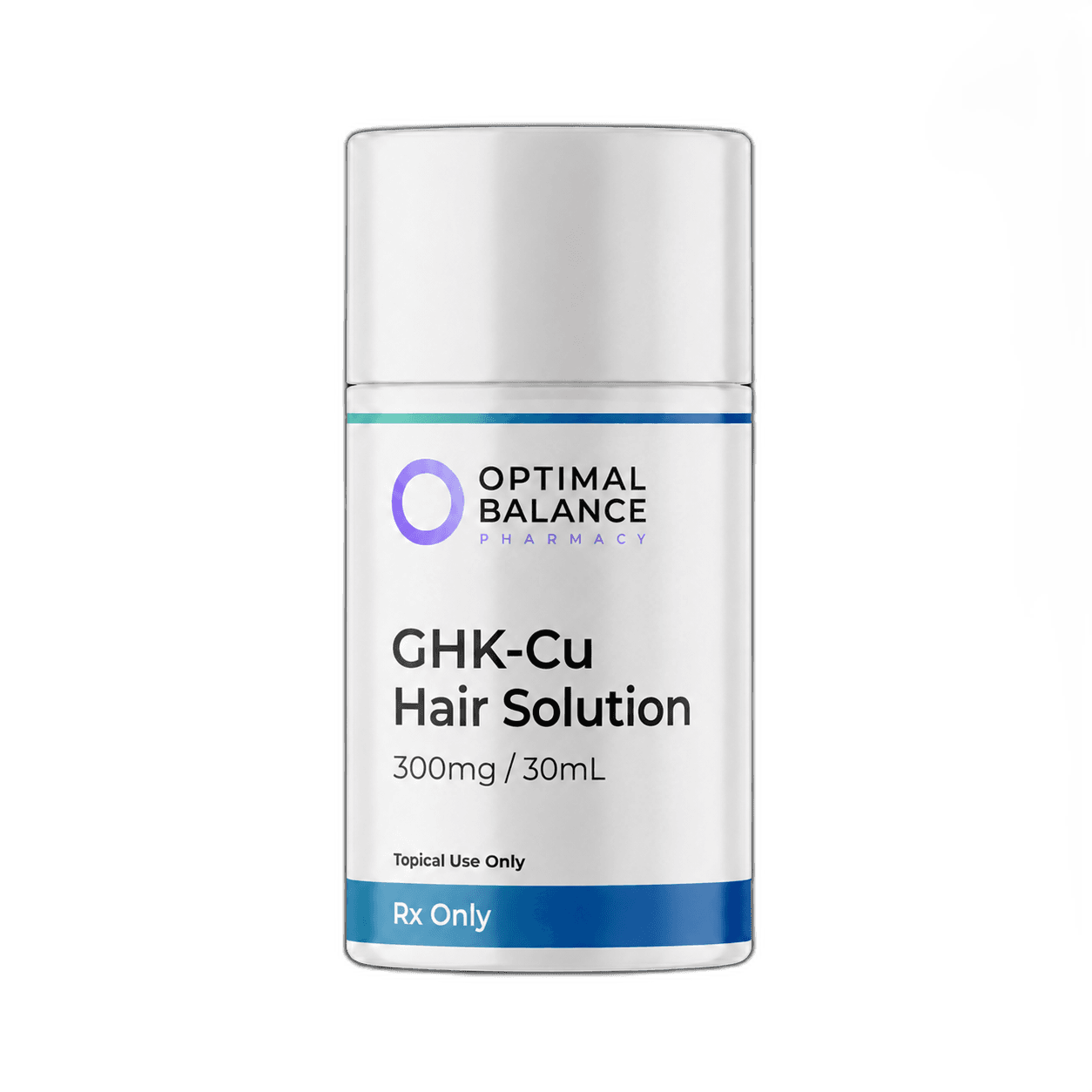
GHK-Cu hair solution
How to get it
A provider decides whether it fits you
We serve 28 states plus Washington, DC. One $39 review covers up to three peptides, and there is no subscription.
Start with the hair solution- 1Complete a short intakeYour history, current medications and anything you already use for your hair.
- 2A provider reviews itA licensed provider reviews it for a one-time $39 and prescribes only if it fits.
- 3The pharmacy ships itOptimal Balance Pharmacy, a licensed 503A pharmacy, compounds and ships it to you.
Frequently asked questions
- Do peptides work for hair loss?
- Copper peptides (GHK-Cu) are the most studied peptide for hair. In lab and animal studies GHK-Cu increased hair follicle size and raised VEGF, a blood-vessel growth signal, and it improved hair transplant success. A controlled human trial of a GHK-Cu scalp solution for hair loss has not been run yet, so most people use it alongside minoxidil or finasteride rather than instead of them.
- What is the best peptide for hair growth?
- GHK-Cu applied to the scalp is the peptide with the most hair-relevant research behind it. Growth hormone peptides such as sermorelin are sometimes marketed for hair, but no controlled trial shows they grow scalp hair.
- Is GHK-Cu better than minoxidil?
- They work differently, and no trial has compared them head to head. Minoxidil has randomized trials showing more hair than placebo. GHK-Cu has lab and animal data on the follicle. Using both is the most common approach: minoxidil first, then GHK-Cu on top in the evening.
- Does GHK-Cu block DHT like finasteride?
- No. Finasteride blocks the enzyme that makes DHT. No published study shows GHK-Cu acts on that enzyme or lowers DHT. It works on the follicle environment instead, which is why some men use both.
- How long until I see results?
- Hair grows slowly. The minoxidil trial measured results at 16 weeks and the finasteride trials at one and two years. Take photos in the same light before you start, and judge any routine over months, not weeks.
- Can women use peptides for hair loss?
- Yes. The GHK-Cu hair solution works the same way for women. Minoxidil is also sold for women. Finasteride is not for anyone who is or could become pregnant. For other goals, see our peptides for women guide.
- When should I see a doctor about hair loss?
- See your own doctor if hair falls out suddenly, in patches, or with other symptoms, or if it starts after a new medication, an illness or rapid weight loss. Thyroid problems, low iron and stress can all cause shedding that needs a different treatment.