GHK-Cu 1% Hair Restoration Solution
GHK-Cu (glycyl-histidyl-lysyl copper) upregulates VEGF expression in dermal papilla cells and modestly inhibits 5-alpha reductase activity, two pathways relevant to follicular regrowth.
 Medically reviewed by Dr. Jonathan Snipes, MD. Last reviewed May 6, 2026.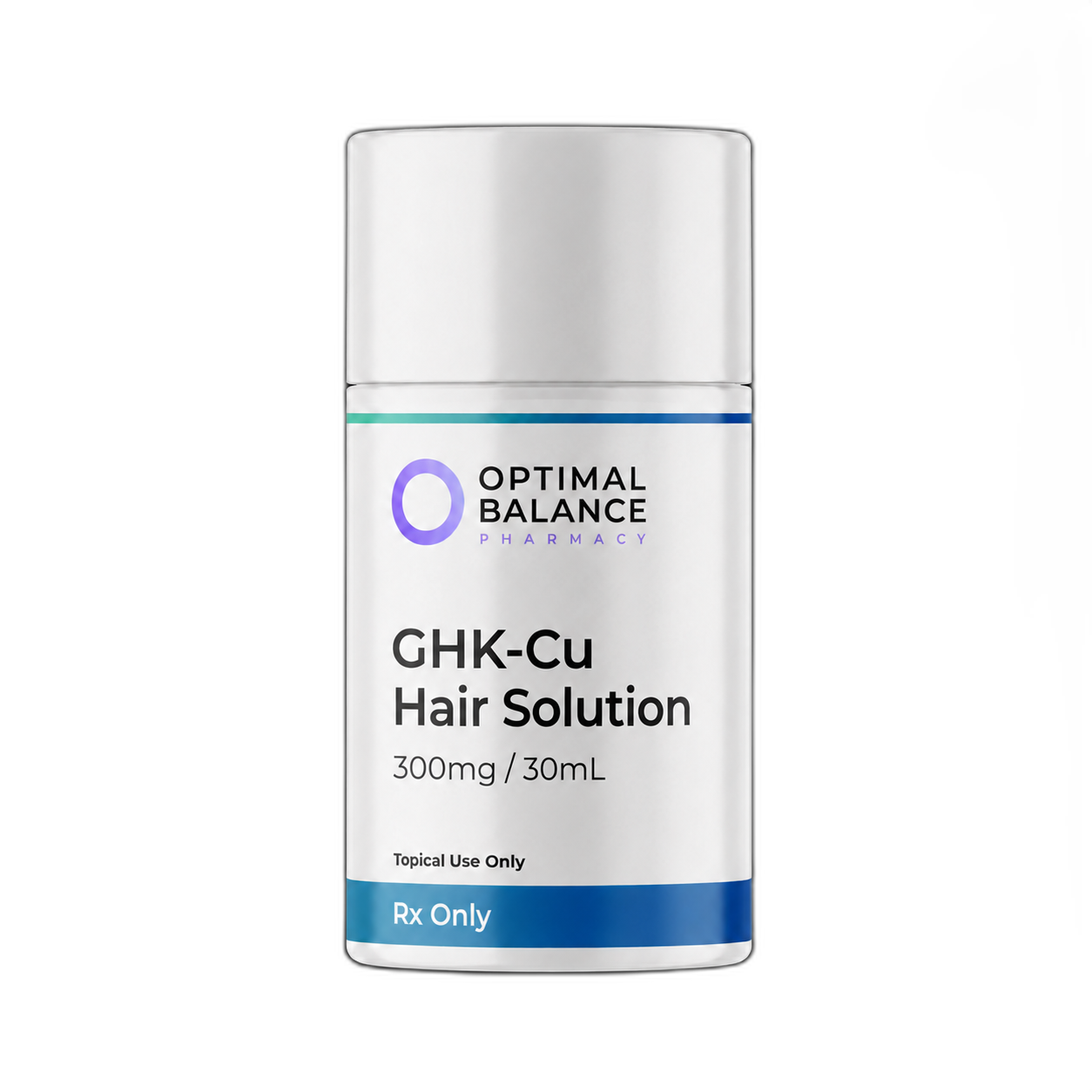
What It Is
A compounded scalp solution containing 1% GHK-Cu (10mg/mL) in a leave-on vehicle. Pickart et al. published the foundational work on GHK-Cu's role in dermal repair; topical formulations show measurable hair density changes over 90 to 180 days in small clinical series. Often layered onto minoxidil or finasteride protocols rather than replacing them.
How It Works
Applied to the scalp once daily, ideally in the evening. The tripeptide-copper complex penetrates the follicle and shifts dermal papilla cell signaling toward the anagen (growth) phase. The aqueous vehicle is designed to leave no residue and be compatible with concurrent minoxidil or finasteride use.
Who It's For
Patients with androgenetic alopecia, telogen effluvium, or general thinning who want a peptide-based adjunct to standard hair-loss treatment. Works for both men and women.
Who Should Avoid It
Known copper allergy. Avoid on broken or inflamed scalp. Discontinue if persistent irritation. Limited topical absorption data in pregnancy or breastfeeding; discuss with provider before use.
Protocol & Pricing
Pharmacy Price
$100/30mL
You pay pharmacy price. No markup.
Starting Dose
1mL applied to scalp once daily
Form
Topical scalp solution (30mL bottle, 10mg/mL GHK-Cu)
Dosing Protocol
Apply 1mL (approximately 20 drops) to clean, dry scalp once daily in the evening. Massage in for 30 seconds. Do not rinse. 30mL bottle covers 30 daily applications. Initial response typically appears at 90 days; full effect at 180 days.
Beyond Use Date
35 Days from compounding (short BUD; use within 5 weeks of fill)
A licensed U.S. 503A compounding pharmacy assigns this date and prints it on your vial label. Always follow the label.
Stacking Guide
Stacks Well With
Topical copper peptide protocol
Read the GHK-Cu 1% Hair Restoration Solution protocol guide
Why prescription compounded GHK-Cu (1 to 3 percent) outperforms The Ordinary, Biossance, and NIOD (0.05 to 0.1 percent). The seven topical peptides Rx Peps Direct prescribes and how to pick between them.
Related Peptides
Cashmere Cream (GHK-Cu 3% / Niacinamide 4%)
Compounded 3% GHK-Cu and 4% niacinamide daily moisturizer. 30 to 60 times the copper-peptide concentration of OTC serums.
$45/30gmGHK-Cu Biocosmetic Cream (GHK-Cu 3% / Estriol 0.3%)
Compounded 3% GHK-Cu with 0.3% topical estriol. Targeted at mature, post-menopausal, or estrogen-deficient skin.
$100/30gmHow to get GHK-Cu 1% Hair Restoration Solution prescribed online
GHK-Cu 1% Hair Restoration Solution is available by prescription through a licensed telehealth visit and dispensed for human use by a licensed 503A pharmacy. That is what separates it from research-use-only vials sold without a prescription. There is no membership, just a medical review fee per order, and automatic refills are optional.
- 1
Complete a $39 medical review. Answer a short intake about your health history and your goals for GHK-Cu 1% Hair Restoration Solution. The $39 fee is the only charge Rx Peps Direct collects, paid once, not a recurring subscription.
- 2
A licensed provider reviews it. A US-licensed clinician reviews your intake and, if GHK-Cu 1% Hair Restoration Solution is appropriate for you, writes a patient-specific prescription. The starting dose is typically 1mL applied to scalp once daily.
- 3
The pharmacy compounds and ships it. A licensed 503A compounding pharmacy in Texas compounds GHK-Cu 1% Hair Restoration Solution and ships it ready to use in its dispensed form by FedEx overnight. Your fill is Topical scalp solution (30mL bottle, 10mg/mL GHK-Cu), and you pay the pharmacy $100/30mL at wholesale, with no clinic markup, plus a $15 flat FedEx overnight shipping fee charged by the pharmacy.
Rx Peps Direct prescribes GHK-Cu 1% Hair Restoration Solution in the 28 states plus Washington, DC where its medical team is licensed. Start a $39 visit or browse the full Skin & Hair range. Comparing services first? See how Rx Peps Direct stacks up against seven other providers in our best telehealth for compounded peptides comparison.
Common questions about GHK-Cu 1% Hair Restoration Solution
- What is GHK-Cu 1% Hair Restoration Solution?
- A compounded scalp solution containing 1% GHK-Cu (10mg/mL) in a leave-on vehicle. Pickart et al. published the foundational work on GHK-Cu's role in dermal repair; topical formulations show measurable hair density changes over 90 to 180 days in small clinical series. Often layered onto minoxidil or finasteride protocols rather than replacing them.
- How does GHK-Cu 1% Hair Restoration Solution work?
- Applied to the scalp once daily, ideally in the evening. The tripeptide-copper complex penetrates the follicle and shifts dermal papilla cell signaling toward the anagen (growth) phase. The aqueous vehicle is designed to leave no residue and be compatible with concurrent minoxidil or finasteride use.
- Who is GHK-Cu 1% Hair Restoration Solution for?
- Patients with androgenetic alopecia, telogen effluvium, or general thinning who want a peptide-based adjunct to standard hair-loss treatment. Works for both men and women.
- How much does GHK-Cu 1% Hair Restoration Solution cost?
- GHK-Cu 1% Hair Restoration Solution costs $100/30mL from a licensed U.S. 503A compounding pharmacy at wholesale, with a flat $39 medical review from Rx Peps Direct. The form is Topical scalp solution (30mL bottle, 10mg/mL GHK-Cu).
- What is the Beyond Use Date for GHK-Cu 1% Hair Restoration Solution?
- A licensed U.S. 503A compounding pharmacy assigns the Beyond Use Date for GHK-Cu 1% Hair Restoration Solution and prints it on the vial label. The listed figure is 35 Days from compounding (short BUD; use within 5 weeks of fill). Always follow the date on your own label.