Recovery & Repair

KLOW

Four synergistic peptides covering tissue repair (BPC-157), systemic recovery (TB-500), copper peptide regeneration (GHK-Cu), and anti-inflammatory immune modulation (KPV).

Dr. Jonathan Snipes, MDMedically reviewed by Dr. Jonathan Snipes, MD. Last reviewed May 6, 2026.
Learn the Science ↓
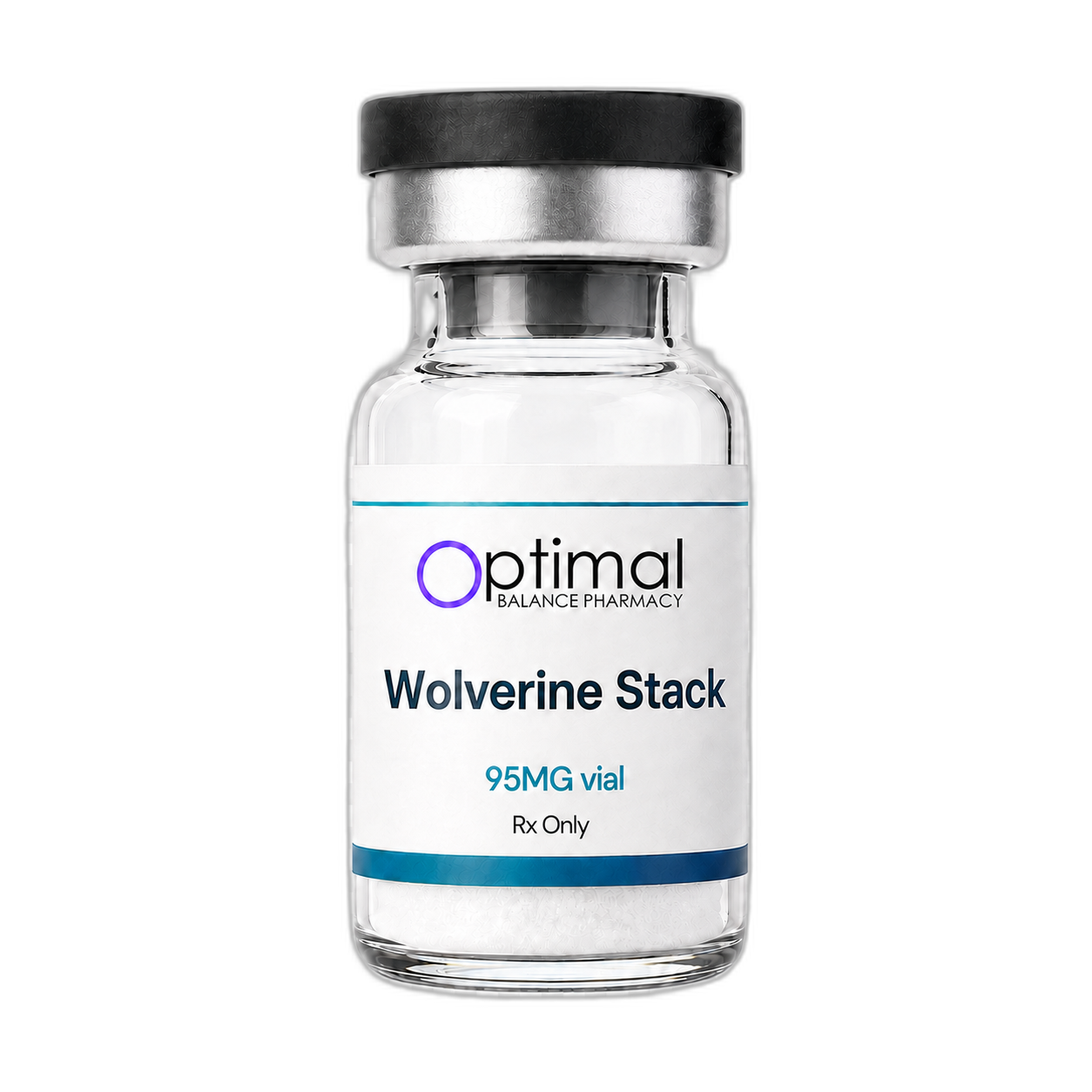
KLOW dispensed by Optimal Balance Pharmacy
KLOW StackFour-Way SynergyRegenerationAnti-Inflammatory

What It Is

KLOW combines four healing peptides in a single vial: BPC-157 for local tissue repair, TB-500 (Thymosin Beta-4) for systemic recovery, GHK-Cu for collagen synthesis and cellular regeneration, and KPV (an alpha-MSH derived tripeptide) for anti-inflammatory immune modulation. The most comprehensive prescription healing protocol available from a 503A pharmacy.

How It Works

Each peptide targets a different aspect of healing: BPC-157 drives local repair, TB-500 promotes cell migration to injury sites, GHK-Cu activates copper-dependent collagen and elastin synthesis, and KPV suppresses NFkB inflammatory pathways. Daily injection delivers all four pathways in a single shot.

Who It's For

Patients seeking maximum healing support: significant injury recovery, post-surgical rehabilitation, athletes with multiple recovery demands, or anyone wanting BPC-157/TB-500 plus the added skin, collagen, and anti-inflammatory benefits of GHK-Cu and KPV.

Who Should Avoid It

Same as component peptides. Flag for active malignancy and autoimmune conditions. Provider monitoring recommended.


Protocol & Pricing

OBP Pharmacy Price

$120/15mg+50mg+15mg+15mg

You pay pharmacy price. No markup.

Starting Dose

20 units (full stack)

Form

Injectable vial (5mL, 3mg-10mg-3mg-3mg/mL, BPC-157 15mg + GHK-Cu 50mg + KPV 15mg + TB-500 15mg total)


Dosing Protocol

20 units subcutaneous injection daily, Monday to Friday. 20 units = 0.2mL delivering BPC-157 0.6mg + GHK-Cu 2mg + KPV 0.6mg + TB-500 0.6mg per injection.

Beyond Use Date

90 Days from compounding (USP <797>)

Optimal Balance Pharmacy assigns this date and prints it on your vial label. Always follow the label. Once a multi-dose vial is punctured, the in-use date on the label is shorter than the compounding date shown here.


Stacking Guide

Stacks Well With

cjc-ipamorelin

Four-peptide recovery stack

Read the KLOW protocol guide

Leads with KPV, the alpha-MSH tripeptide with the clearest preclinical anti-inflammatory data, then explains the BPC-157 / TB-500 / GHK-Cu stack and states plainly that the four-peptide blend has no combined human trial. Honest about what is mechanism and what is proof.

Read guide

Related Peptides


Independently tested

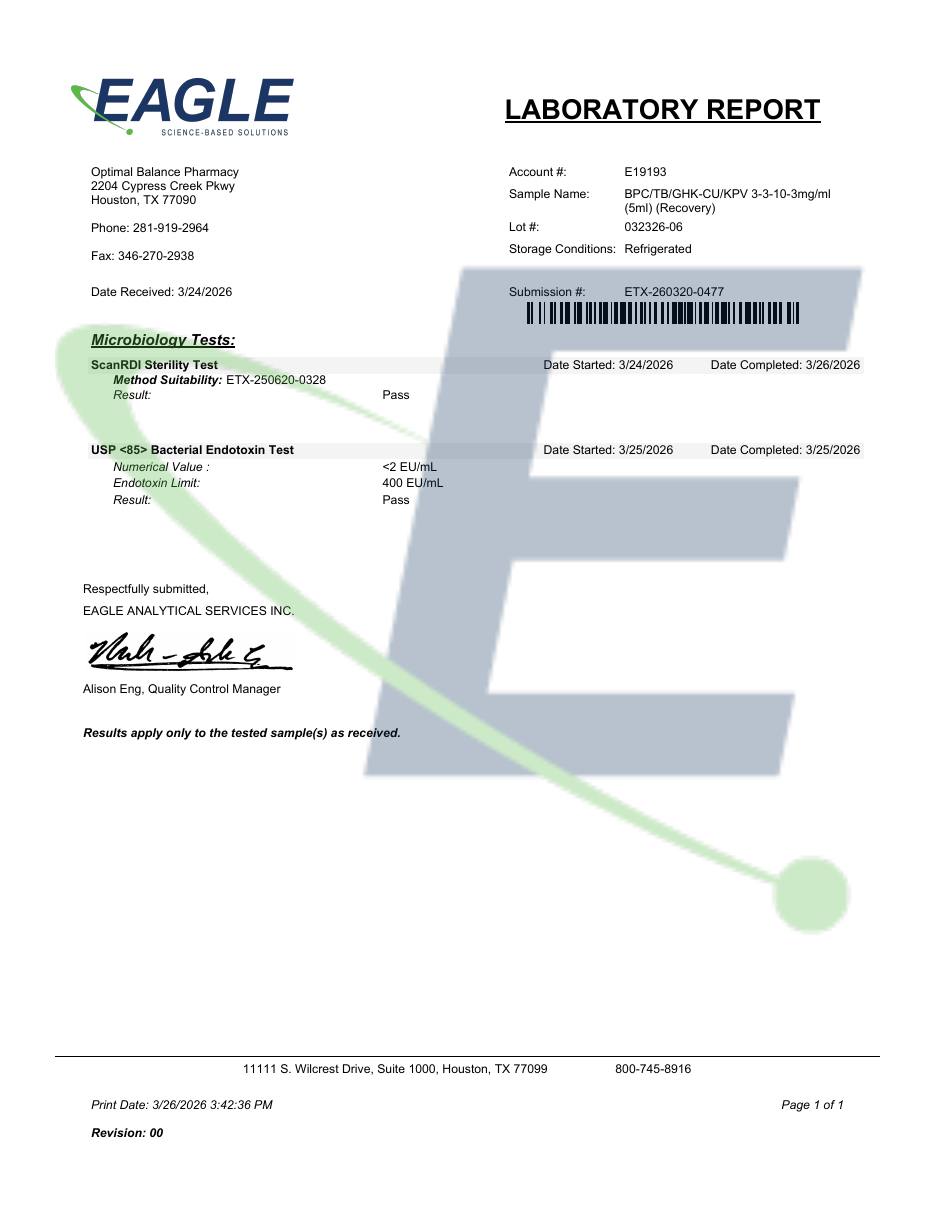
KLOW lab test reports

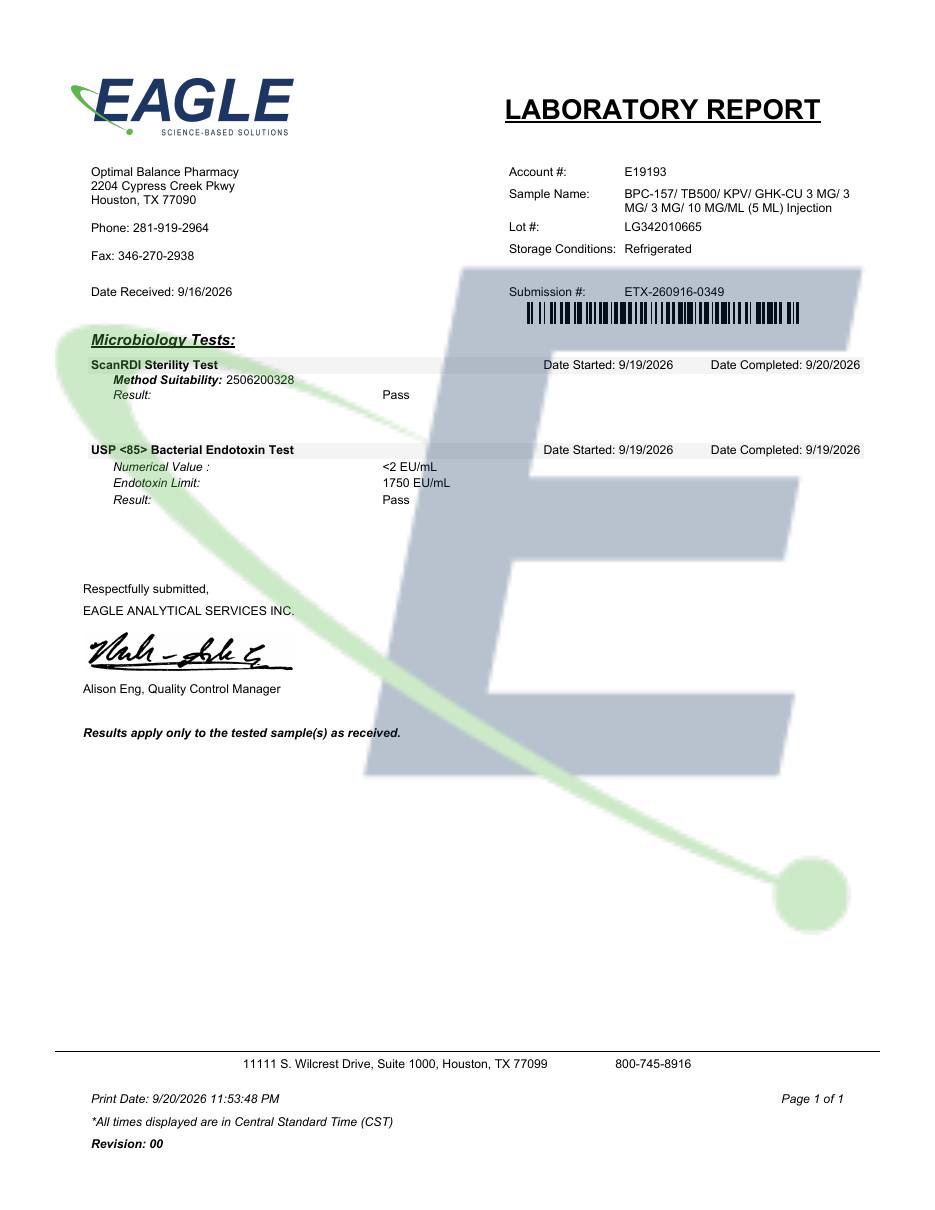
Every KLOW batch dispensed by Optimal Balance Pharmacy is independently tested by Eagle Analytical Services (FDA-registered, A2LA ISO 17025 accredited) for sterility (ScanRDI or Celsis) and bacterial endotoxin (USP <85>). The most recent report:

SubmissionLotSampleSterilityEndotoxinPDF
ETX-260320-0477032326-06BPC/TB/GHK-CU/KPV 3-3-10-3mg/ml (5ml) (Recovery)Pass
Pass

<2 EU/mL / 400 EU/mL

Download

Eagle Analytical Services is an independent FDA-registered laboratory, A2LA accredited to ISO 17025, based in Houston, Texas. They have no commercial relationship with RxPepsDirect. RxPepsDirect prescribes; Optimal Balance Pharmacy compounds and dispenses; Eagle tests every batch. Three separate companies. Browse our full quality program on the quality page.


How to get KLOW prescribed online

KLOW is available by prescription through a licensed telehealth visit and dispensed for human use by a named 503A pharmacy. That is what separates it from research-use-only vials sold without a prescription. There is no subscription and no membership, just a one-time visit fee.

  1. 1

    Complete a $39 medical visit. Answer a short intake about your health history and your goals for KLOW. The $39 fee is the only charge RxPepsDirect collects, paid once, not a recurring subscription.

  2. 2

    A licensed provider reviews it. A US-licensed nurse practitioner or physician reviews your intake and, if KLOW is appropriate for you, writes a patient-specific prescription. The starting dose is typically 20 units (full stack).

  3. 3

    The pharmacy compounds and ships it. Optimal Balance Pharmacy, a 503A pharmacy in Texas, compounds KLOW and ships it pre-reconstituted by FedEx overnight in a reusable cooled case. Your fill is Injectable vial (5mL, 3mg-10mg-3mg-3mg/mL, BPC-157 15mg + GHK-Cu 50mg + KPV 15mg + TB-500 15mg total), and you pay the pharmacy $120/15mg+50mg+15mg+15mg at wholesale, with no clinic markup, plus a $15 flat FedEx overnight shipping fee charged by the pharmacy.

RxPepsDirect prescribes KLOW in the 28 states its medical team is licensed in. Start a $39 visit or browse the full Recovery & Repair range. Comparing services first? See how RxPepsDirect stacks up against seven other providers in our best telehealth for compounded peptides comparison.


Common questions about KLOW

What is KLOW?
KLOW is a single compounded injectable combining four peptides: BPC-157 (associated with tissue repair), TB-500 (an N-acetylated seven-amino-acid fragment of thymosin beta-4, associated with cell migration), KPV (an alpha-MSH derived anti-inflammatory tripeptide), and GHK-Cu (a copper tripeptide associated with collagen synthesis). The RxPepsDirect vial lists BPC-157 15mg, TB-500 15mg, KPV 15mg and GHK-Cu 50mg in 5mL. No published human trial has evaluated the complete four-peptide blend as one treatment.
Is KLOW the same as the Wolverine Stack?
No, and the distinction matters when comparing products. Wolverine Stack is the common name for BPC-157 plus TB-500 only, which RxPepsDirect sells as a separate two-peptide vial. KLOW adds GHK-Cu and KPV to those two. KLOW also differs from GLOW, which contains BPC-157, TB-500 and GHK-Cu but not KPV. KPV is the ingredient that distinguishes KLOW from GLOW. No head-to-head human trial has established better outcomes for any of these blends over another.
Why all four peptides together?
Each ingredient has a separate proposed mechanism: BPC-157 in growth-factor signalling, TB-500 in cell migration, KPV in inflammatory tone, and GHK-Cu in collagen and elastin synthesis. Those mechanisms are drawn largely from laboratory and animal research, and combining them in one vial has not been shown in a controlled human study to work better than the ingredients used separately. Blends are also more expensive to compound, so KLOW sits among the higher-priced formulations.
How is KLOW dosed?
The prescription label and your prescriber's directions control the dose. KLOW is a fixed-ratio blend, so one volume sets all four doses at once and they cannot be adjusted individually. The listed starting protocol is 20 units subcutaneously, Monday to Friday: 20 units is 0.2mL, delivering 0.6mg BPC-157, 0.6mg TB-500, 0.6mg KPV and 2mg GHK-Cu. Per-ingredient dose ranges published for single-peptide vials do not transfer to this product and cannot be reproduced from it.
How long should I take KLOW?
No validated course length exists for this blend, so duration comes from your written prescription rather than from a standard protocol. Prescribers commonly treat it as episodic rather than continuous, in part because cumulative copper exposure from GHK-Cu and ongoing immune modulation are reasons for caution over long uninterrupted use. Your provider sets the cycle length and any breaks.
Is KLOW allowed for tested athletes?
No. BPC-157 is prohibited under WADA category S0 (non-approved substances) and thymosin beta-4 derivatives including TB-500 are prohibited under S2. Athletes subject to the WADA Code or another anti-doping programme should check the current prohibited list and their governing body before treatment.
How is KLOW supplied?
Compounded by Optimal Balance Pharmacy under a 503A patient-specific prescription. Ships pre-reconstituted and ready to inject in cold-chain packaging. GHK-Cu contains copper, so a prepared solution often looks blue. Batches are tested by Eagle Analytical Services for sterility and bacterial endotoxin, and the Certificate of Analysis is published on this product page. Those two tests address microbial contamination; they do not establish ingredient identity, potency, purity or stability.